

Are Chinese Vessels Circling Greenland? Lessons Learned about China’s Role in the Arctic


The Xue Long Polar-Capable Research Vessel. Photo : https://commons.wikimedia.org/wiki/File:Chinese_icebreaker_Xue_Long.jpg
In January we visited the Maritime Museum in Vancouver, British Columbia which exhibits the Royal Canadian Mounted Police Arctic patrol vessel, the St. Roch, the second vessel to transit the Northwest Passage (in 1940-42) after Roald Amundsen’s pioneering voyage (1903-06).

The RCMP St. Roch in the Vancouver Harbour; Photo: https://commons.wikimedia.org/wiki/File:St._Roch_ship_Vancouver.jpg
The St. Roch traveled west to east, exiting the Northwest Passage near Greenland. This brought to mind recent claims about Chinese vessels in the vicinity.
The PRC’s first polar-capable research vessel, the Xue Long (Snow Dragon), made the same voyage from west to east as a part of a 2017 circumpolar expedition, the first for a Chinese ship. The Xue Long, purchased from Ukraine in 1993, had previously paid a visit to Tuktoyaktuk, Northwest Territories, during its maiden scientific voyage through the Northwest Passage in 1999, surprising Canadians and raising questions about the adequacy of monitoring in the Far North. In 2016, China announced the publication of a 356-page Chinese-language nautical guide to the Northwest Passage, which Canada considers to be its internal waters.
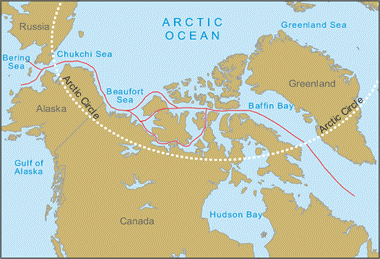
The Norwest Passage (in red) connects the Bering Sea with the Atlantic Ocean through the Canadian Arctic archipelago. Map: Hobart King, https://geology.com/articles/northwest-passage.shtml
Despite all the recent assertions in the White House to PRC vessels allegedly circling Greenland, the 2017 voyage of the Xue Long circumnavigating the Arctic Rim is the most recent sighting of a Chinese ship in the area. As Danish Foreign Minister Lars Løkke Rasmussen pointed out, there hasn’t been a Chinese ship near Greenland in nearly a decade.
In its enthusiasm to participate in the region, the PRC government declared itself a “near-Arctic state” (regardless of the contradicting geographic reality) and became an observer member of the Arctic Council. It’s been eight years since China published its White Paper on the Arctic, a high-level official blueprint of the country’s Arctic agenda. In that document, the Chinese government pledged to participate in the Arctic based on the principles of “respect, cooperation, win-win result and sustainability.”
And yet, despite the picture of China achieving free rein in the Arctic, Chinese officials and businesses have faced many obstacles.
What went wrong for Beijing?
This story is worth retelling, both to understand the limits of PRC influence, and as a cautionary tale about the dos and don’ts of participation in the region.
Interest by PRC companies in investments in the Arctic raised security concerns. Although Arctic communities need investment for development, they are small and remote, enabling an outsized investor to have disproportionate influence, however beneficial the investment. Moreover, these investment efforts proceeded at a time of growing concern about economic and technological competition with China and its increasing military assertiveness in the Indo-Pacific. Given this climate, many investments by PRC firms in Arctic states stalled or failed. However, even a small number of investments could have an outsized impact on individual Arctic communities given the vast disparity between their economic power and China’s. Future articles will address some of these specific cases.
Some PRC investments and science diplomacy raise dual-use concerns. China’s military speaks of the polar regions, as well as the undersea and space technologies needed to explore and develop them, as “new strategic frontiers.” The potential dual use of infrastructure like satellite ground stations and undersea mapping by the PRC’s military as well as by scientists has led to new scrutiny of PRC Arctic research activities as well as of its investments in infrastructure. When Chinese companies sought to buy a former naval base in Greenland (2016) and renovate an airport (2018), for example, the Danish government intervened to prevent this.
The PRC’s use of economic sanctions called attention to the drawbacks of vulnerability to PRC economic leverage. As Chinese companies sought to invest in the Arctic, the PRC imposed sanctions on an increasing number of countries to signal displeasure with various policies and actions taken by these governments. These included Arctic states such as Norway, Denmark, and Sweden. It took six years for China to end its boycott of Norway for awarding the Nobel Peace Prize to Chinese dissident Liu Xiaobo in 2010, a cautionary tale.
“Wolf warrior” diplomats—nationalistic officials in the style of a Chinese action hero from the Wolf Warrior action films— made things worse by threatening journalists and officials in Arctic states who pushed back against PRC policies and demands. A leaked audio recording revealed, for example, that in 2015 China’s Ambassador to Denmark threatened to deny the Faroe Islands, an autonomous territory within the kingdom, access to the Chinese market unless the Faroese government selected Huawei as the 5G operator. A series of such undiplomatic incidents only made Nordic states more wary of the potential for coercion by the PRC.
Tensions with China over trade imbalances, technological competition, and critical mineral supply chains spilled over into the Arctic. By 2019, the European Union labeled China a “systemic rival.” This led to a derisking strategy, to reduce dependence on the Chinese market, and an effort to diversify key supply chains, especially critical minerals. This means that Arctic states now see a role for PRC companies, especially state-owned ones, in developing critical minerals in Greenland and elsewhere in the Arctic with a security lens as well as an economic one.
Russia became China’s best partner in the Arctic. As China’s primary gatekeeper to the Arctic, Russia has the leverage to determine how and where China could participate in the Russian Arctic, despite its growing economic dependence on Beijing since the 2022 full-scale war on Ukraine. While often frustrating and expensive (Russia charges mandatory fees for navigation services on the Northern Sea Route), the China-Russia partnership has provided opportunities for PRC companies to expand their use of the waterway, provide technology to the Yamal LNG projects (taking the place of western firms), and receive shipments of gas. This led to Coast Guard cooperation between China and Russia as well as an increase in military exercises and patrols, both alone and together, in the Bering Sea. As I and others have written, the North Pacific Arctic is where Chinese and Russian vessels can be found regularly and we should focus our attention there, not on Greenland.
China’s partnership with Russia in the Arctic is another reason for NATO Arctic states to distance from Beijing, as Russia is perceived as the primary threat to the Euro-Atlantic Arctic. Chinese Arctic experts chafe at this tainting by association, which is part of a broader trend, especially in Europe, toward viewing China as a key enabler of the Russian full-scale war in Ukraine. Zhao Long and Li Fan bemoan the “stigmatization” of Sino-Russian partnership and the ascendance of security concerns in the Arctic, to the detriment of opportunities for China to participate in the region.
One silver lining for Beijing is that current tensions between the US and NATO allies seem to be inspiring a series of resets in relations. Witness recent visits by the prime minsters of the United Kingdom, Canada, and Finland to Beijing.
Where’s the risk for China? The ongoing competition over technology and critical minerals against the background of the Russian war on Ukraine is likely to set limits to any recent enthusiasm for engagement in European capitals.
Voyages by vessels such as the St. Roch and the Xue Long demonstrate a capability to operate in a challenging Arctic maritime space. For an outsider like China, that’s just one step on its quest to participate more fully in the region.
Nevertheless, leveraging economic power and threats did not prove to be a great strategy for expanding influence in the Arctic. Sound familiar?
Many thanks to Samuel Robertson for his research assistance.
Please note that this blog now can also be found on Substack


Comments