

China’s Orbán Risk and the Future of China-EU Relations

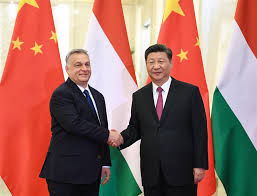
On April 12th, Viktor Orbán—Hungary’s strongman leader for the past 16 years—was defeated resoundingly at the polls. A thorn in the side of the European Union, Orbán also was China’s most important friend in Europe and the first European country to sign a Belt and Road Initiative agreement. One week later, the election in Bulgaria of Rumen Radev as prime minister—typically portrayed as “pro-Russian” and a “Euroskeptic seemed to counterbalance the news out of Budapest. However, the EU’s 20th package of sanctions on Russia, issued on April 23rd in response to its aggression in Ukraine, revealed the real risk to China’s relations with the EU. And it was not Orbán’s departure, but Beijing’s strategic partnership with Russia. For the first time Chinese firms were included in the sanctions. because of the PRC’s support for Russia’s war.
Loss of the Hungarian ‘Bridgehead’
Many Chinese commentators accentuate the positive in their assessments of their country’s future relations with Hungary under the new Magyar government. “It is absurd to conclude that ‘Sino-Hungarian relations will turn hostile’ or that ‘China has suffered a defeat’ based on this, Guancha [Observer] columnist Xue Kaihuan writes. According to Xue,10 years of economic integration, including PRC US$8.5 billion investment in the massive CATL battery plant, crucial to Hungary’s integration into EV supply chains in Europe, and the establishment in 2025 of BYD’s R&D headquarters for Europe, create strong incentives for the new government to stay the course in economic ties with China. Xue predicts “minor tweaks” in Sino-Hungarian relations, but no major disruption. Many other PRC observers agree, arguing that economic interests will lead Magyar to take a pragmatic approach to China.
Changes in the implementation of Sino-Hungarian economic relations are likely, as the new government seeks a more cooperative relationship with the EU, other PRC experts point out. Feng Zhongping, director of the Institute of European Studies at the Chinese Academy of Social Sciences, predicts more attention to the transparency of PRC investments and their compliance with EU regulations and preferences, especially on the level of economic exposure of EU economies to China.
The change in government in Budapest will have real political consequences for China, however. As Jian Junbo, director of the Center for China-EU Relations Studies at Fudan University, commented, “we can no longer regard Hungary as a 'bridgehead.'” The Magyar government may opt to restrict economic and trade cooperation with China and more closely scrutinize the environmental impact of investments and pay greater attention to human rights issues. Similarly, Hungary will no longer play the role of “vetoman,” another PRC journalist observed. She noted that Orbán could be counted on to criticize or obstruct EU resolutions criticizing China’s policies on Hong Kong, Taiwan, and Xinjiang, but Magyar already has pledged to pursue more mainstream policies toward the EU and reduce Hungary’s reliance on China.
Bulgarian Countermove
One week after Magyar’s landslide win in Hungary, parliamentary elections in Bulgaria raised hopes in Beijing and Moscow that a new Orbán had emerged. Compared to Hungary, China’s trade and investment ties with Bulgaria are modest, though growing. The newly elected Prime Minister has referred to China as a “strategic ally” and visited Beijing in 2019. However, like European observers, Chinese commentators see little chance that Prime Minister Radev will obstruct EU policies. One PRC analysis saw the new Bulgarian leader pursuing a pragmatic policy line, noting that a recent European poll found that 56% of Bulgarians opted for the EU as their main strategic ally and just 19.6% chose Russia, a major decline since the 2022 full-scale war in Ukraine when 60% favored Russia. Another PRC observer noted that Bulgaria’s foreign policy orientation was a matter of speculation since the new prime minister had yet to outline his foreign policy. Unlike Magyar, Radev will need the support of a pro-EU party to govern however, making it unlikely that he will have the political capital to replace Orbán as the EU’s main irritant or China’s primary supporter.
Reengagement with the EU and China’s Russia Risk
Some recent diplomatic activity—such as visits by the Spanish Prime Minister’s and other EU officials to Beijing against a background of US-NATO tensions—have raised hopes in some quarters in China about a possible China-EU reengagement. Nevertheless, the Russian war on Ukraine, now in its fourth year, and China’s role as a key enabler of the conflict, have created a new impediment to EU-China ties. The EU’s 20th package of sanctions against Russia targeted Chinese entities for the first time, including 28 in China and Hong Kong and an additional 16 in third countries. China protested strongly and then retaliated by imposing “dual-use” restrictions on seven EU companies, ostensibly for their ties to Taiwan. Interviewed on April 22nd, Finland’s Prime Minister Elina Valtonen called China’s close ties to Russia “a disqualifying factor” that presents a major obstacle to the China-EU trade deal that has languished since 2021.
Despite all the attention to Orbán’s defeat as a key obstacle to China’s European ambitions, it is the Sino-Russian strategic partnership that has put Beijing’s efforts to reengage with the EU at risk. This is a risk not easily addressed as Beijing’s ties to Moscow are deepening in response to other perceived risks to China that are even more substantial—regime security, border security, and energy security, just to name a few. These will be addressed in future posts.
Dive Deeper
Ágnes Szunomár, “Hungary-China Relations After the Elections: A Pragmatic Recalibration?” https://chinaobservers.eu/hungary-china-relations-after-the-elections-a-pragmatic-recalibration/.
Alexander Kolyandr, “Russia and the Pain of Losing Hungary,” April 16, 2025, https://cepa.org/article/russia-and-the-pain-of-losing-hungary/.
Asya Metodieva and Dimitar Keranov, “China’s Quiet Strategy in Bulgaria,” July 2025, “https://www.gmfus.org/news/chinas-quiet-strategy-bulgaria-economic-appeal-political-constraints#:~:text=China%20maintains%20relations%20with%20several,rule%20of%20law%2C%20and%20democracy.
Emilia Zankina, Kevin Deegan-Krause, and Tim Haughton, “What Rumen Radev’s victory means for Bulgaria, the EU and Russia,” April 21, 2026, http://blogs.lse.ac.uk/europpblog/2026/04/21/bulgaria-election-results-rumen-radev-progressive-bulgaria/.
“Profiling European countries' resilience towards China,” October 31, 2024, https://merics.org/en/report/profiling-european-countries-resilience-towards-china.

Comments