

Two's Company and Three's a Risk

China's Perspective on a Trilateral Meeting with Russia and the US

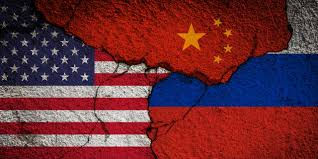
Vladimir Putin ambushed Xi Jinping last month with a proposal for a trilateral side-summit with Donald Trump at the November 18-19 APEC meeting in Shenzhen, China. If Xi declines, he’s a bad host. If he accepts, he needs to find a topic where all three can agree—this is no small ask. Trump wants to discuss nuclear arms control, but Xi doesn’t because of the disparity between China’s nuclear arsenal and the US and Russian stockpiles. Putin wants to discuss Ukraine to impose a solution, but again Xi doesn’t—for fear of appearing to divide up Ukrainian territory without its participation or the presence of Europe at the negotiating table. Xi wants a controlled, limited meeting, but Trump wants a more flexible format where nuclear arms control is discussed.
There’s been a lot of media commentary about a 21st century Yalta Conference, but such a world-shaping event is not the trilateral meeting that Putin has in mind. He is most likely thinking along the lines of the Russia-India-China trilaterals, where Moscow plays the pivotal role since Russia has better relations with India and China than they have with each other. This framework, first proposed in 1998, has yet to resolve Sino-Indian differences, however—Russia continues to arm both sides. The three held a video-conference right after the most recent Sino-Indian border clashes, but have not met again since 2021. The purpose of the Russia-India-China framwork is to promote Russia’s role in creating a new security architecture and its commitment to a multipolar world order.
In Shenzhen, Russian China-watcher Nikolai Vavilov contends that Russia sees an opportunity for Russia to serve as a bridge between the US and China and “mediate the brewing conflict between Beijing and Washington.” According to Alexei Mukhin, director of the Centre for Political Information, a political consultancy in Moscow, the trilateral could be “a starting point for resetting the global security architecture and resolving the trade war between Washington and Beijing.” Or, as Russian Press Secretary Dmitry Peskov put it, “it will be interesting and capture the attention of the whole world.”
What might China achieve in such a meeting? On the optimistic side, Wang Wen, a dean and professor at the Chongyang Institute for Financial Studies at Renmin University of China, hopes that the trilateral would support UN efforts to create a multipolar order and “inject certainty in a multipolar world.” Other experts are more cautious. Zhou Bo, a retired PLA officer who made a sensation overseas for his candid publications about Russia’s war in Ukraine, contends that a trilateral format might at best achieve a mechanism for mutual notification of missile launches. For his part, Zhu Feng, a prominent scholar and dean at Nanjing University, dismissed trilateral talks as a distraction from the main event, which in his view should be for China and the US to find a way to control their areas of disagreement. Other Chinese experts cautioned about the misaligned goals of the three leaders but expressed hope that China would gain by showing that its involvement contributed to global stability.
Chinese officials typically prefer bilateral meetings where the agenda can be better controlled and avoid multilateral formats, especially with less powerful states. Although not a formal ally, strategic partner Russia has managed to put China in a risky position where it is difficult for Xi to decline the meeting and hard for him to embrace the agenda Russia and the US have proposed. If the trilateral occurs, most likely it will more closely hew to Xi’s preferences and be more pomp and less substance. As the Chinese saying goes, 客随主便 (kè suí zhǔ biàn) or the guest should follow the host’s wishes.


Comments